

How to Treat Shoulder Pain
If you’re reading this, chances are that you’ve had shoulder pain at some point in your life. Why? Because shoulder pain is very common. The shoulder has more range of motion than any other joint in the body, leaving it vulnerable to irritation with daily activities and exercise.
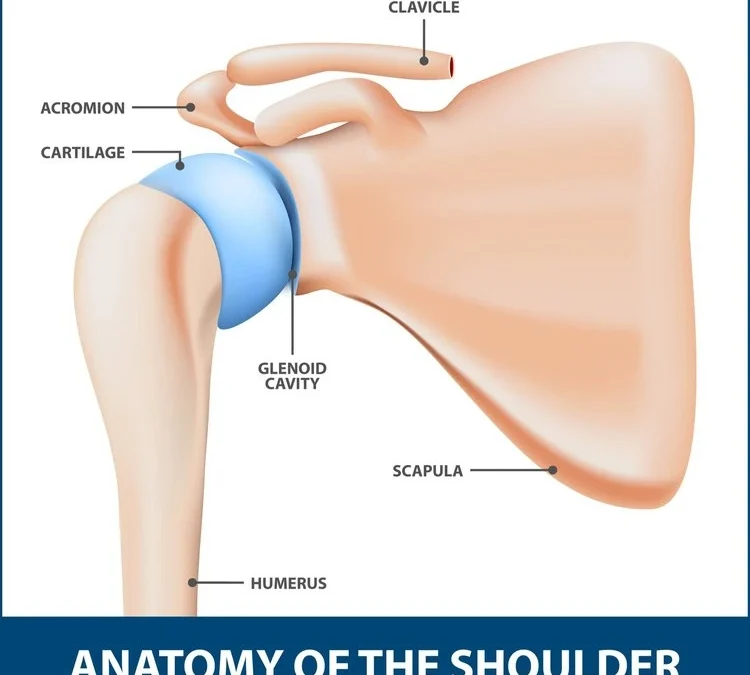
The shoulder joint is comprised of your humerus (upper arm) and your scapula (shoulder blade) along with tons of muscles, tendons, and ligaments all within that small space. This means that if your workout volume or shoulder mechanics are suboptimal, it’s easy for a structure to get irritated. This also means that it can be difficult to identify exactly what is aggravated, although our current understanding of injuries tells us that it’s also not necessary. What we DO need is to figure out what is causing that irritation, and address that.
The most common causes we see for shoulder pain are excessive workout volume, mobility impairments, and stability impairments.
Volume
Volume is the total amount of reps and sets we are doing for a particular body part (in this case, our shoulders). Sometimes it’s useful to have an objective opinion to tell us that we may be over-doing things and using excessive volume. Fitness programs like CrossFit prescribe shoulder related activities frequently. When the amount of volume we do exceeds our ability to recover, that’s when we get in trouble. The effects of this are amplified if we have deficits in mobility and stability. Pay attention to how often your workouts involve shoulder dominant activities and ask for modifications if your shoulders are feeling overworked.
Mobility Impairments
If you have difficulty achieving a sound overhead position easily, the structures in your shoulder are more likely to get irritated as you attempt to achieve that range of motion. There are two boxes to check in order to ensure optimal overhead position: shoulder flexion and thoracic extension. Taking a few minutes to mobilize prior to overhead activities can help you move more comfortably and efficiently. Here’s what I would recommend:
Overhead Loaded Lat Stretch
Move your arms overhead to the point of a stretch. Staying in that end-range position, take 5 deep breaths. Bend your elbows to bring your arms back down to your side. Repeat 2-3 more times.
If you have discomfort in the top of your shoulder with this stretch, try modifying it to have your palms facing the opposite direction.
Thoracic Extension Over Foam Roller
Keep your ribs locked down to isolate movement to the upper back.
Repeat 10-15 times.
Stability Impairments
Even if you have a strong strict press or you can hammer out a lot of pull-ups, chances are you could still benefit from some stability training. Your rotator cuff is active during all movements of your shoulder and helps to keep your arm centered with your shoulder blade, decreasing the chance of irritation to one of the many structures in your shoulder. Your serratus anterior also plays a massive role in how your arm functions over your head. The serratus anterior helps to rotate your shoulder blade upward and tilt it posteriorly. If these things aren’t happening, there is less “space” for structures to fit under a bony structure, called your acromion, without getting irritated. Here are a few of my favorite ways to train shoulder stability:
External Rotation Uppercut
This exercise hits both your posterior rotator cuff and your serratus anterior in a functional range of motion.
3 sets of 10-20 reps
Scap Push Ups:
Regress to scap push ups from an elevated surface or progress to single arm scap push ups.
3 sets of 5-15 reps
½ Kneeling KB Windmill:
A drill to train time under tension and increase overhead stability.
3 sets of 5-10 reps
Try these exercises to improve your shoulder mobility and stability while paying attention to the total volume of shoulder related work you are doing in your program. If you are still dealing with shoulder pain or mobility issues that are limiting you in the gym, give us a call and we’d be happy to help.